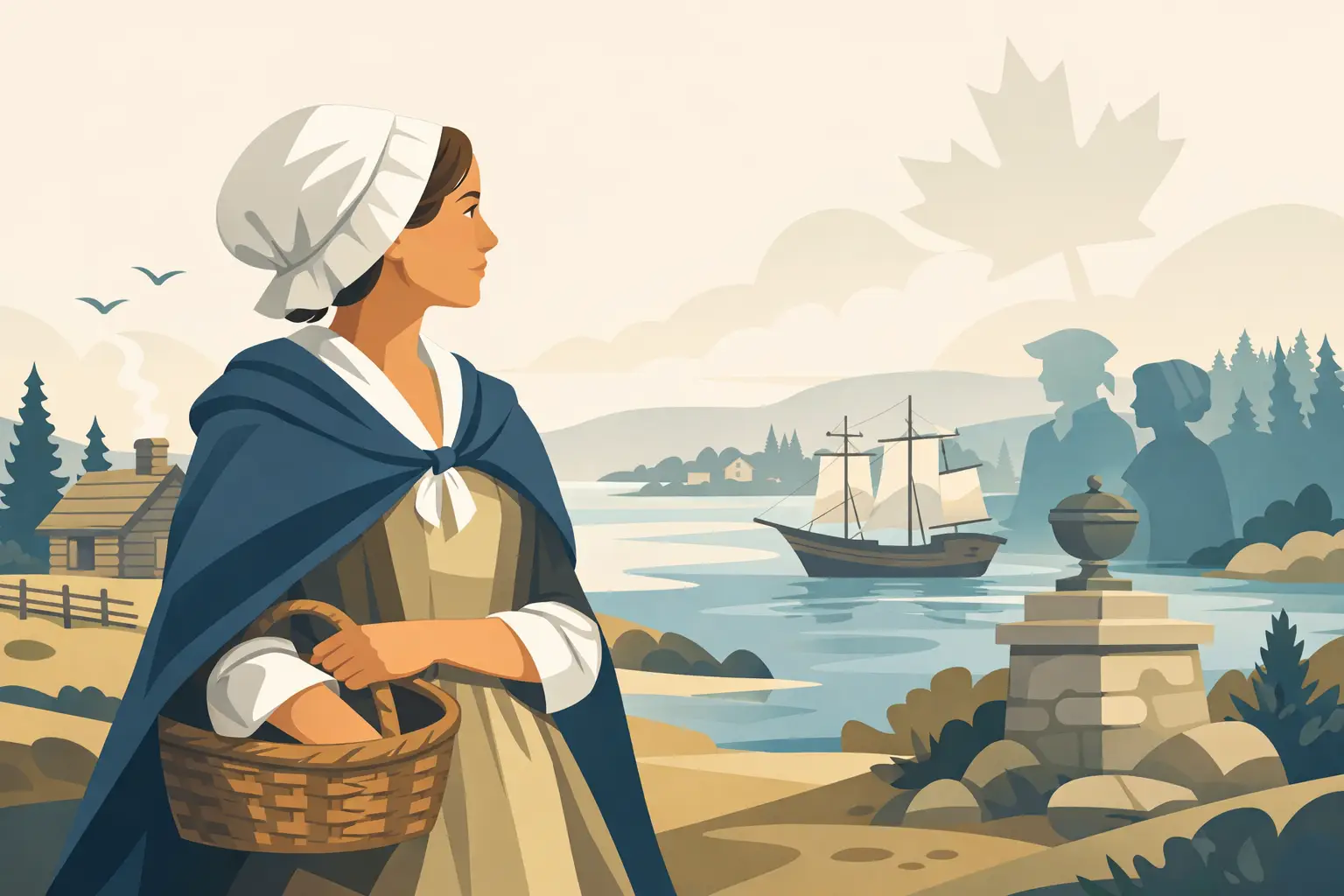
When people speak of the Loyalist founding of this country, they often picture soldiers, survey lines, and grants of land. Yet the true weight of settlement was also borne by women whose names seldom appear in the grander telling. Loyalist women in Canada crossed borders in grief and uncertainty, buried children, kept families together, cleared wilderness, and carried memory from one broken world into another. If we are to understand how early Canada was built, we must begin to see the women who endured it.
Why loyalist women in Canada matter
The American Revolution did not simply divide armies and legislatures. It shattered households. For many families who remained loyal to the Crown, departure was not an abstract political choice but an uprooting of everything familiar. Farms were lost. Property was seized. Neighbours became enemies. What followed was not a noble procession into comfort, but years of displacement, privation, and rebuilding.
Women lived that rupture in intimate ways. They were not standing at the margins of events. They were carrying infants onto crowded boats, rationing food in temporary camps, nursing the sick, mourning the dead, and trying to hold some form of order while the old life disappeared behind them. In that sense, Loyalist women were not merely companions to settlement. They were among its chief architects.
This is where the history becomes both richer and more honest. A settlement is not made only by the granting of acreage. It is made by the daily labour that turns uncertainty into continuity. Bread had to be baked. Cloth had to be mended. Illness had to be met. Children had to be taught what had been lost and what might still be built. These were not small domestic footnotes. They were the foundations of survival.
Beyond the familiar Loyalist narrative
Traditional accounts of the United Empire Loyalists have often leaned toward military service, political allegiance, and male heads of household. Those elements matter, but they do not tell the whole story. A family did not arrive in Upper Canada as a legal unit alone. It arrived as a living, vulnerable community of bodies, fears, duties, and hopes. Women were central to that reality.
Many Loyalist women in Canada left only the faintest paper trail. A husband may be listed on a land petition. A son may appear in militia records. The woman who carried the family through winter, childbirth, widowhood, or hunger may survive in the archive only as a given name, or not at all. That absence has shaped the public memory of the era.
But silence in the record does not mean silence in life. It means historians, descendants, and writers must look more carefully. Church registers, family traditions, cemetery stones, petitions, local histories, and regional memory all help restore a fuller picture. When read together, they reveal women who were steady in faith, formidable in endurance, and indispensable to community formation.
The work they carried
To speak of pioneer hardship can sometimes flatten the lived texture of it. The hardship was not generic. It was physical, constant, and often lonely. Loyalist women in early Canada were expected to create shelter out of rough conditions and make homes in landscapes that offered little immediate comfort.
They cooked over open hearths, hauled water, tended gardens, preserved food, spun yarn, made clothing, and cared for the young and old. They faced childbirth without modern medicine and illness without reliable treatment. In many settlements, they also endured profound isolation, especially in the first seasons when roads were poor, neighbours distant, and supplies scarce.
Yet their work was more than labour. It was culture-bearing. Through prayer, language, custom, recipe, song, and moral instruction, women carried continuity from one generation to the next. A child born in a cabin in Upper Canada still inherited a family world shaped by a mother’s memory and discipline. That transmission mattered. It helped turn a settlement into a society.
There is a temptation to romanticize this endurance, and we should resist it. These women were brave, but they were not immune to exhaustion, bitterness, grief, or fear. To honour them properly is not to turn them into symbols polished beyond recognition. It is to see them as human beings who kept going when circumstances gave them little reason to expect ease.
Hoople Creek and the local truth of history
The most moving Loyalist history is often local. It lives in creeks, concessions, churchyards, and family names that still echo across eastern Ontario. In places such as Hoople Creek, the story of settlement becomes tangible. It is no longer a broad national tale but a human one, attached to particular women who cooked in particular kitchens, prayed in particular homes, and were buried in particular soil.
That local focus matters because it resists the tendency to make early Canada feel distant and abstract. When we narrow our attention to a district, a family line, or a circle of matriarchs, we begin to understand how nation-building actually occurred – not as rhetoric, but as repeated acts of faithfulness under strain.
This is why matriarch-centred storytelling carries such power. It restores scale. It reminds us that history was lived at the level of the household. The building of Canada did not happen only in councils and campaigns. It happened where women fed others before feeding themselves, where they mourned privately and persevered publicly, and where they taught children to belong to a place still rough with beginnings.
For descendants, this approach can be especially meaningful. A woman once known only as an ancestor’s wife becomes visible as a person with courage, convictions, and burdens of her own. Family history deepens when women are given back their full humanity.
How remembrance changes the story
There is a moral dimension to recovering these lives. Historical neglect is not always intentional, but it has consequences. When women disappear from the story, the nation’s origins become narrower, harder, and less truthful than they were. We inherit a past shaped only by public deeds and miss the private endurance that made those deeds possible.
Remembering Loyalist women in Canada does more than correct the record. It changes how we understand belonging. These women were builders of continuity in a time of rupture. They gave shape to communities that would outlast them. They offered labour, faith, and maternal strength to a country still taking form.
That remembrance also asks something of us. It asks patience with fragmentary evidence. It asks humility about what cannot be fully known. In some cases, we can reconstruct a life with confidence. In others, we must proceed with care, drawing near through context, family patterns, and regional history without claiming more than the sources allow. That balance matters. Reverence is strongest when it remains honest.
One thoughtful response to this challenge is narrative history grounded in research. When done well, it does not replace the archive. It gives emotional shape to what the archive alone can struggle to convey. Works such as The Matriarchs of the Hoople Creek Loyalists show how carefully rendered storytelling can honour real women without losing sight of historical truth. For many readers, especially descendants, that kind of writing opens the past in a way a ledger or petition never could.
What their legacy means now
Modern Canada is far removed from the frontier world those women knew, but their legacy has not faded. It lives in rural churches and old cemeteries, in family Bibles and oral traditions, in place names, and in the stubborn pride many Canadians feel toward ancestors who endured displacement and began again.
Still, legacy is not automatic. It survives only if it is carried forward. That means teaching younger generations that women were not background figures in Loyalist history. It means supporting local heritage work, preserving graveyards and records, and reading history that makes room for women as protagonists rather than supporting characters.
It also means accepting complexity. Not every Loyalist woman experienced settlement in the same way. Class, age, health, family size, widowhood, and geography shaped outcomes. Some found stability sooner than others. Some lived long enough to see prosperity emerge. Others gave everything and died before the promise of the new land was fulfilled. That unevenness does not weaken their story. It makes it more real.
To remember them well is to speak their place in the making of Canada with gratitude and clarity. They were not incidental to the Loyalist experience. They were among its strongest pillars, bearing exile, settlement, motherhood, labour, and memory with a strength the country still owes a debt.
If we listen for them with care, loyalist women in Canada are no longer absent figures at the edge of the page. They stand where they have always belonged – at the heart of the story, waiting to be named, honoured, and remembered.
Leave a Reply