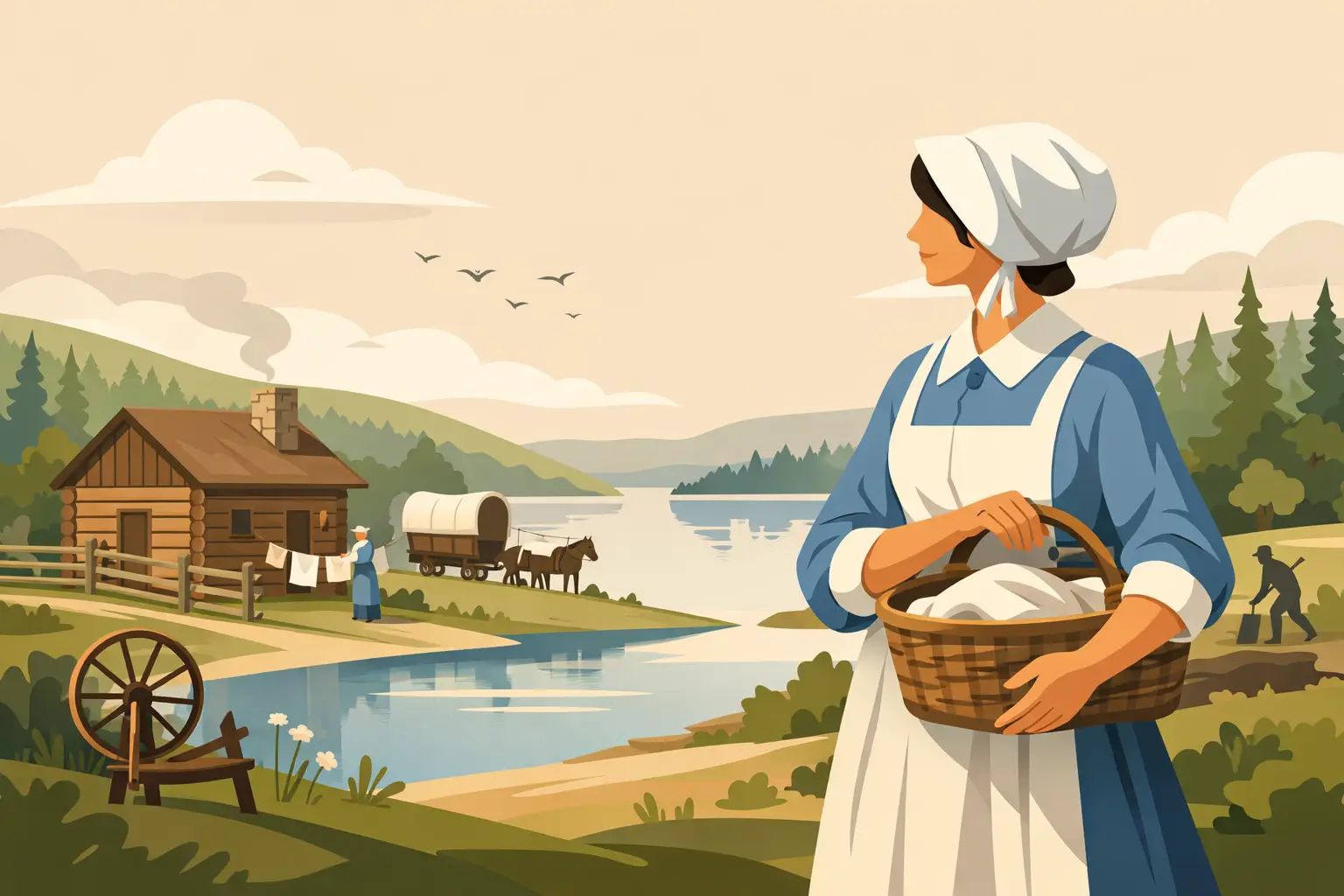
When we speak of settlement in early Ontario, too often we picture surveyors, soldiers, and male landholders. Yet the story of Upper Canada pioneer women is written just as deeply into the soil. It lives in the cabins raised from green timber, in the children carried through hunger and winter, in the fields cleared by family labour, and in the prayers spoken at gravesides far from the homes these women had once known.
To remember them properly is not to add a footnote to a familiar national tale. It is to restore the missing centre. These women were not merely companions to settlement. They were builders of households, keepers of memory, guardians of faith, and steady hands in a land that demanded almost everything a family possessed.
Why upper Canada pioneer women matter
Upper Canada was not settled by endurance alone, but by endurance made daily and practical. That work often fell to women in ways the surviving records only partly reveal. A petition may name a husband. A militia list may honour a man. A deed may pass between male signatures. But between those formal lines was the unrecorded labour that made life possible.
A pioneer woman cooked over open flame, spun and mended, preserved food, tended illness, bore children, and often worked beside her family outdoors as necessity required. She managed scarcity not as an occasional hardship but as a condition of life. If livestock failed, if crops were poor, if fever entered the house, she carried the burden in body and spirit.
This matters because the making of Canada was not accomplished only through public acts. It was also accomplished through private endurance. A nation begins in homes before it appears in institutions, and many of those homes held together because women refused to surrender to exhaustion, grief, or isolation.
Life in Upper Canada was harsher than memory sometimes allows
There is a tendency in heritage storytelling to soften pioneer life into quaint images – a hearth, a bonnet, a neat log house by the road. The truth was sterner. For many families, arrival in Upper Canada meant uncertainty from the start. Land had to be reached, trees had to be cleared, shelter had to be improvised, and food security was never guaranteed.
For women, hardship was intensified by responsibility. Pregnancy did not pause for winter. Childbirth did not wait for a doctor. Illness spread quickly in cramped quarters. Death, especially among infants and young children, was a familiar sorrow. Even where a family held hope and conviction, daily life could be marked by fatigue so complete it is difficult for modern readers to imagine.
And yet these women persisted. They made garments from limited cloth, turned gardens into insurance against hunger, and learned the seasonal rhythms of a demanding land. They also formed the social fabric that kept settlements from becoming mere clusters of struggling households. A neighbouring woman at a birth, a shared loaf in a lean season, a visit after bereavement – these were not small kindnesses. They were part of survival.
The Loyalist experience shaped many Upper Canada pioneer women
For many families in eastern Ontario and beyond, the pioneer story cannot be separated from the Loyalist story. Women who came as part of United Empire Loyalist migration had already lived through upheaval before they ever began the work of settlement in British North America. Some had seen property lost, communities fractured, and loyalties tested at profound personal cost.
That history matters because it gave their arrival in Upper Canada a particular gravity. They were not simply moving westward in search of opportunity. In many cases, they were rebuilding life after dislocation, war, and exile. Their labour in a new settlement was tied to memory – memory of what had been surrendered, and of what must now be remade.
This is why the women of Loyalist communities deserve such careful remembrance. They carried continuity across rupture. They bore the customs, convictions, family identities, and moral resolve that helped transform unsettled ground into rooted community. Along places such as Hoople Creek in eastern Ontario, that work was not abstract. It was lived in kitchens, at spinning wheels, in fields, and beside rough-hewn beds where the sick were nursed through the night.
What the records tell us – and what they leave out
Anyone who studies early Canadian families learns a difficult truth. Women are often present in the past, but not fully visible. They appear as wives, widows, daughters, or mothers in legal and church records, yet their inner lives are rarely preserved in their own words. We may know a birth date, a marriage, a burial place, perhaps a land connection through a husband or son. But character, fear, resolve, tenderness, and private grief often remain hidden.
That absence does not mean these lives were ordinary in the diminished sense of the word. It means the archive was built around different priorities. If we are to honour Upper Canada pioneer women faithfully, we must read with care and imagination disciplined by evidence. We must notice the widow petitioning to keep a farm together, the mother raising children after loss, the family line sustained because one woman endured circumstances that might have broken another.
This is also where narrative history has a rightful place. When handled with historical seriousness, it can restore texture to lives flattened by recordkeeping. It can bring readers nearer to what these women likely carried – duty, loneliness, courage, faith, and the fierce determination to preserve family against relentless uncertainty.
Upper Canada pioneer women built more than households
To speak only of domestic labour would still be too narrow. These women helped shape communities of conscience and belonging. They transmitted language, prayer, manners, loyalties, and memory. They taught children how to understand suffering, obligation, and kinship. They preserved continuity between generations in a colony still finding its form.
Their influence extended beyond the walls of the home. In many settlements, women supported church life, informal care networks, seasonal cooperation, and the moral order of the community itself. Even where they held little formal authority, they exercised profound social power. Without that influence, many pioneer settlements would have remained fragile and transient.
There is also a trade-off in how we speak of their strength. We should honour resilience, but not romanticize suffering. These women were admirable not because hardship is noble in itself, but because they met hardship with endurance that sustained others. To remember them well is to feel gratitude without pretending the cost was light.
Why descendants feel these stories so deeply
For descendants, the appeal of this history is not merely academic. It is familial, local, and personal. A woman in a faded register entry may be the reason a family line continued in Canada at all. A burial ground by a rural church, a surname still known along an old concession road, a treasured story handed down across generations – these are often the traces by which descendants feel history become intimate.
That is why women’s stories matter so much in genealogical and regional heritage work. They give emotional structure to lineage. They remind us that ancestry is not only a chain of names, but a chain of sacrifices. When a descendant understands what an ancestress endured to keep children fed, clothed, and alive in Upper Canada, family history acquires moral weight.
In this sense, remembrance is not nostalgia. It is an act of justice. It says that those who laboured without public honour will not remain unnamed in spirit, even where the records have been sparse.
How we should remember upper Canada pioneer women today
We should remember them with accuracy, but also with feeling. A purely sentimental portrait diminishes them, and so does a dry recital of dates. Their lives deserve both research and reverence. They deserve to be placed where they belonged all along – at the centre of the settlement story.
That work can take many forms. It may begin in a family tree, a cemetery visit, a local history society, or a carefully written book that gives voice to those long kept silent. The form matters less than the intent. What matters is that we refuse to let these women disappear behind the better-documented men of their generation.
For readers drawn to the Loyalist experience in eastern Ontario, works such as The Matriarchs of the Hoople Creek Loyalists answer this need by bringing historical women forward as fully felt human beings rather than background figures. That kind of storytelling does more than inform. It restores presence.
The women who endured the first years of Upper Canada left more than descendants behind them. They left examples of constancy under strain, faith under sorrow, and courage expressed not in grand declarations but in daily acts of care. If we listen closely, their legacy still speaks – in our communities, in our family names, and in the quiet duty to remember them with honour.
Leave a Reply